As the year wraps up, we’re wishing you a holiday season and new year filled with music and new connections.
Vocalist Paul Marinaro couldn’t be home for Christmas with his mom this year, so he and pianist Ben Lewis recorded this tender performance of Kent, Gannon, and Ram’s “I’ll Be Home for Christmas” for her. Though both musicians live in Chicago, they couldn’t find a time and place to meet in person, but with FarPlay, they were able to make their recording online in about ten minutes on Christmas morning.
Want to make music with Ben and other musicians on FarPlay? Ben’s weekly jazz jams and Eden Casteel’s weekly open mics continue in the new year on FarPlay Meet, our platform that lets you connect with the wider FarPlay community, free to all subscribers. To be among the first to experience Meet, sign up now for early access to the beta. Then, to browse sessions (or create your own), look under Open Sessions. Thanks to everyone who helped test FarPlay Meet this year!
How far apart can you play together?
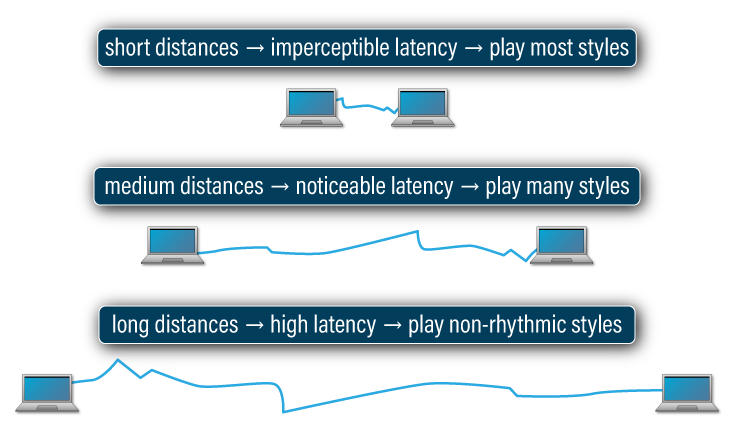
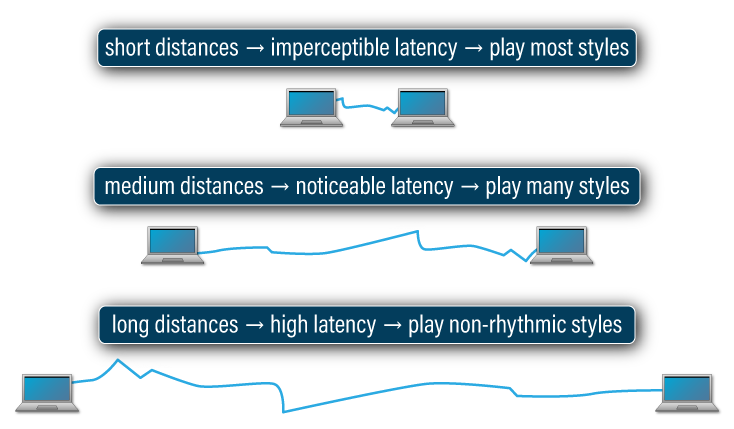
Musicians are often surprised to learn that the answer is a lot farther than they expect. When network connections and computer and audio-device performance are optimized, latency is imperceptible at short distances. At medium distances, latency is noticeable, but musicians can still play a wide variety of styles together. For long distances, latency is too high for playing together in rhythm, but playing non-rhythmic music together can still be fun! Check out the recordings of different styles and distances in our new blog post on this topic.
Monthly support sessions
Sign-ups are available for the first monthly support sessions of 2026, which will be Saturday, January 17th and Saturday, February 21st, 2:00pm-3:30pm New York time (8:00pm-9:30pm Central European time) on both dates. Sign up for support sessions here.
Monthly tech-support sessions are available free to paid subscribers and students of FarPlay For Teachers subscribers. These sessions are a great way to get live tech support for FarPlay and FarPlay Meet.
Get in touch
We love featuring our amazing users. If you’d like to be included — whether you use FarPlay for lessons, rehearsals, jam sessions, or conversations — we’d love to talk to you. You can let us know by emailing us at contact@farplay.io.
Need help right away? Check out our FAQ & Troubleshooting Guide, which you can open from the Help menu in the latest version of FarPlay. If you haven’t already, upgrade free to the latest version.
If you’d like to ask tech-support questions, our forum is the fastest way to reach us. If you need to reach us privately, email us at support@farplay.io — we’re happy to help!
We get this question a lot! Musicians are often surprised to learn that the answer is a lot farther than they expect.
The time it takes for the sound one musician makes to reach another musician’s ears is called latency.
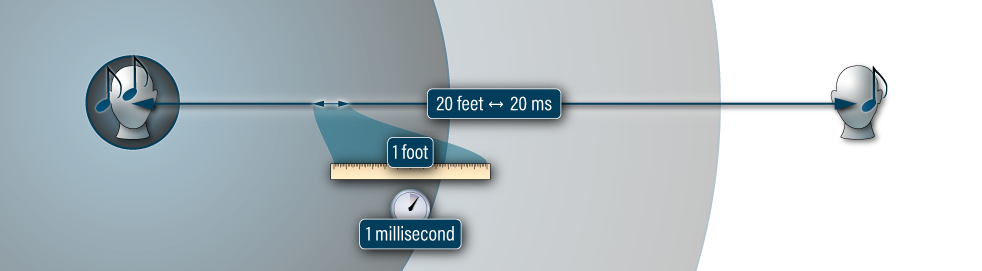
Even when playing together in the same room, there’s some latency, because sound travels through air at about 1 foot per millisecond (ms), meaning it takes about one thousandth of a second for sound to travel one foot (or 3 ms to travel 1 meter). Studies have shown that musicians start to notice latency when it exceeds about 20 ms one-way, about as long as it takes for sound to travel from one musician to another 20 feet (7 m) away in the same room. For some styles of music, latencies up to 45 ms or more can be acceptable; for example, musicians at opposite ends of a symphony orchestra, often 50+ feet apart, regularly experience latencies over 50 ms.
When you play music together over the internet, latency and audio quality depend on factors including network connections (for example, fiber has lower latency than cable), distance, and computer and audio-device performance. For details, check out our latency tutorial.
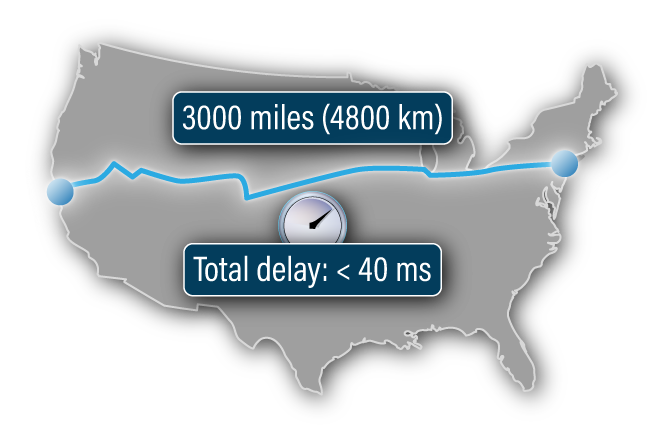
When internet connections and computer and audio-device performance are optimal, latency mainly depends on distance between musicians. Information can’t travel faster than the speed of light, physics tells us, so the farther you are from someone you’re playing with, the longer it takes for audio data to travel between you. Under good network conditions, FarPlay can produce latencies below 40 ms even with 3000 miles (4800 km) of distance between participants, and well below 20 ms within 1000 miles (1600 km).
At short distances, latency is essentially imperceptible. At medium distances, latency is noticeable, but musicians can still play a wide variety of styles together. For long distances, latency is too high for playing together in rhythm, but playing non-rhythmic music together can still be fun! How far you can play depends on performance styles, as the examples below show.
Rhythmically precise styles
Fast percussion, playing the same rhythms on instruments with fast attacks, and clapping together to teach rhythms in lessons all make latency noticeable at relatively short distances.
For musicians in the same or nearby cities, latency can be low enough even for math metal. In this example, Brittany Anjou (piano), Rich Bennett (guitar), and Noah Garabedian (bass) rehearse “Daughter Laughter” by the Friendly Bears. Brittany writes, “We are pretty astounded and pleased how easy it was to rehearse with FarPlay even though we all live in three different neighborhoods in Brooklyn.”
Baroque music is rhythmically detailed and precise. Even so, a distance of 120 miles (200 km) is small enough for Marco Pierobon (trumpet, Parma, Italy), Francesco Gibellini (trumpet, Reggio Emilia, Italy), Stefano Ammannati (tuba, Genova, Italy), and Aldo Pizzagalli (trumpet, Lugano, Switzerland) to stay locked together in time as they perform a stirring rendition of Jean-Joseph Mouret’s “Fanfare-Rondeau”.
In Johan Eriksson’s trio’s rhythmically driving arrangement of Chopin’s Prelude in D Major below, the bass, guitar, and piano play together on most beats, which would easily reveal any latency issues, but the nearly 700 miles (1100 km) they’re playing across is still close enough for sounding as together as they’d sound in one room.
If you try to line up percussion and plucked notes at distances well beyond 1000 miles, latency is unquestionably audible, as in the lesson excerpt below. Here, Oteil Burbridge played bass guitar from California with Nikki Glaspie on drums in New York, a 2900-mile drive away. But notice also that the bass and drums are playing different rhythms, rather than in unison, so the latency is subtle and perfectly acceptable for this style of music lesson.
Accompanying vocalists
A duet between a singer and an instrumentalist is much less demanding than the styles above, as far as latency is concerned, because singing usually has more smooth onsets and fewer fast attacks, compared with struck or plucked instruments.
Stephannie Moore on vocals in Florida and Ben Lewis on piano in Chicago are a 1400-mile drive apart. Yet, they perform Sara Bareilles’s “She Used To Be Mine” with the same kind of tender, intimate sound you might expect from musicians sharing a stage at a night club.
At a distance of 4000 miles between New York City and Dresden, mezzo-soprano Valerie Eickhoff and pianist Elenora Pertz experienced a latency of about 55 ms, which was subtly noticeable to them as they played, but they’re still able to rehearse Clara Schumann’s song “Ich stand in dunkeln Träumen” beautifully.
Jazz improvisation
Jazz is a highly rhythmically sophisticated art form. If, for example, you want to play an uptempo Bebop head in unison, you’ll need latency below 20 ms. However, the freedom inherent in jazz improvisation makes rhythmic improvisation possible even over wide distances, depending on tempo and instrumentation. For example, because it’s common for singers to float or back-phrase, a piano-voice duet will be able to tolerate higher latency than a bass-drums duet.
Our own Dan Tepfer in Brooklyn and Thomas Enhco in Paris, France improvised rhythmically together on piano in this live broadcast performance of Chuck Wayne’s jazz standard “Solar”, 3600 miles (6000 km) apart.
Free improvisation
At distances that prevent playing together at all but the slowest tempos, musical styles that don’t emphasize rhythm, such as drone music, ambient music, or non-pulsed free improvisation can remain comfortably playable, as Dan Tepfer on piano in Brooklyn and Seigo Matsunaga on double bass in Kyushu, Japan, demonstrate. At a distance of 6800 miles (11000 km), they had around 80 ms of latency, definitely noticeable, but not a problem for this style of real-time music making.
How far do you play with FarPlay?
The easiest way to find out whether FarPlay works for your distances, internet connections, musical styles, etc. is to test FarPlay for free. Check out our requirements and get set up with our QuickStart guide.
You can use FarPlay’s free mode to create as many 1:1 sessions as you like (each up to 45 minutes long). To try out group (multi-user) sessions, use our Standard and Standard+ subscriptions, which include a free trial month. These subscriptions include additional premium features, like recording (compare plans). Speaking of recordings, feel free to send us yours. We’d love to share them on our socials and showcase how far you play with FarPlay!